Pimeyes face search alternative:Is there a site better than PimEyes?
Looking for a PimEyes face search alternative? This page lists reliable options and explains which tools work better for privacy, social media image checks, and misuse detection.


 Fake Account Detection & Removal
 DMCA Takedown Service
 Onlyfans Creator Protection
 Private Photo Protection
 Revenge Porn Removal
 AI Image Abuse Detection
 For Creator
 For Individuals
 General
 Twitter Shadowban Test
 Instagram Shadowban Test
 Tiktok Shadowban Test
 Creator Platform Comparison Tool
 OnlyFans Restricted Words Checker
 OnlyFans Caption Generator
 Blog
Blog DMCA Guides
 Affiliate Program
 Email
Email X(Twitter)
 Telegram
Most people never worry about video leaks — because for most people, it’s not a real risk.
This issue tends to surface in very specific situations: when videos are created for an audience, tied to income, or shared with the expectation of privacy.
That includes creators and brands dealing with unauthorized reposts, adult or paywalled content being copied to piracy sites, and people who shared a video privately and later started to wonder where it might have ended up.
If you’re in one of these situations, the concern isn’t theoretical.
It’s practical:
How do you know whether your video is actually leaked — and how can you check without making the situation worse?
This guide focuses on exactly that.
A video is considered leaked when it is shared or reposted beyond the audience you intended, especially in ways that affect privacy, control, or revenue.
In practice, this usually means:
It does not mean:
Once a video crosses into unauthorized distribution, it’s worth checking.
You can confirm reuploads using a reverse search tool that matches visual content instead of filenames.
Checking whether a video is leaked requires different methods than searching for photos or text.
Videos are easier to alter, harder to index, and more likely to be reposted in fragments. That’s why effective checks focus on how leaks actually spread, not just where you expect to find them.
Searching for an entire video file rarely works.
Leaked videos are often renamed, trimmed, clipped, or re-encoded. Instead of searching the full file, extract two or three clear frames from the video and start there.
The most useful frames usually include:
These frames are far more likely to match reposted or altered versions online.
Leaked videos don’t spread evenly across the internet.
Most reposts appear on:
This is why a single search engine query often isn’t enough. Many leaks live outside obvious results.
Manual searches have limits, especially when content is altered.
Reverse search tools work by matching visual similarity, not filenames or captions. This matters because leaked videos are often reposted using different titles, new accounts, or cropped clips.
Tools like Erasa allow searches using multiple inputs:
By checking across frames, faces, and photos, you reduce the risk of missing reposts that don’t closely resemble the original upload.
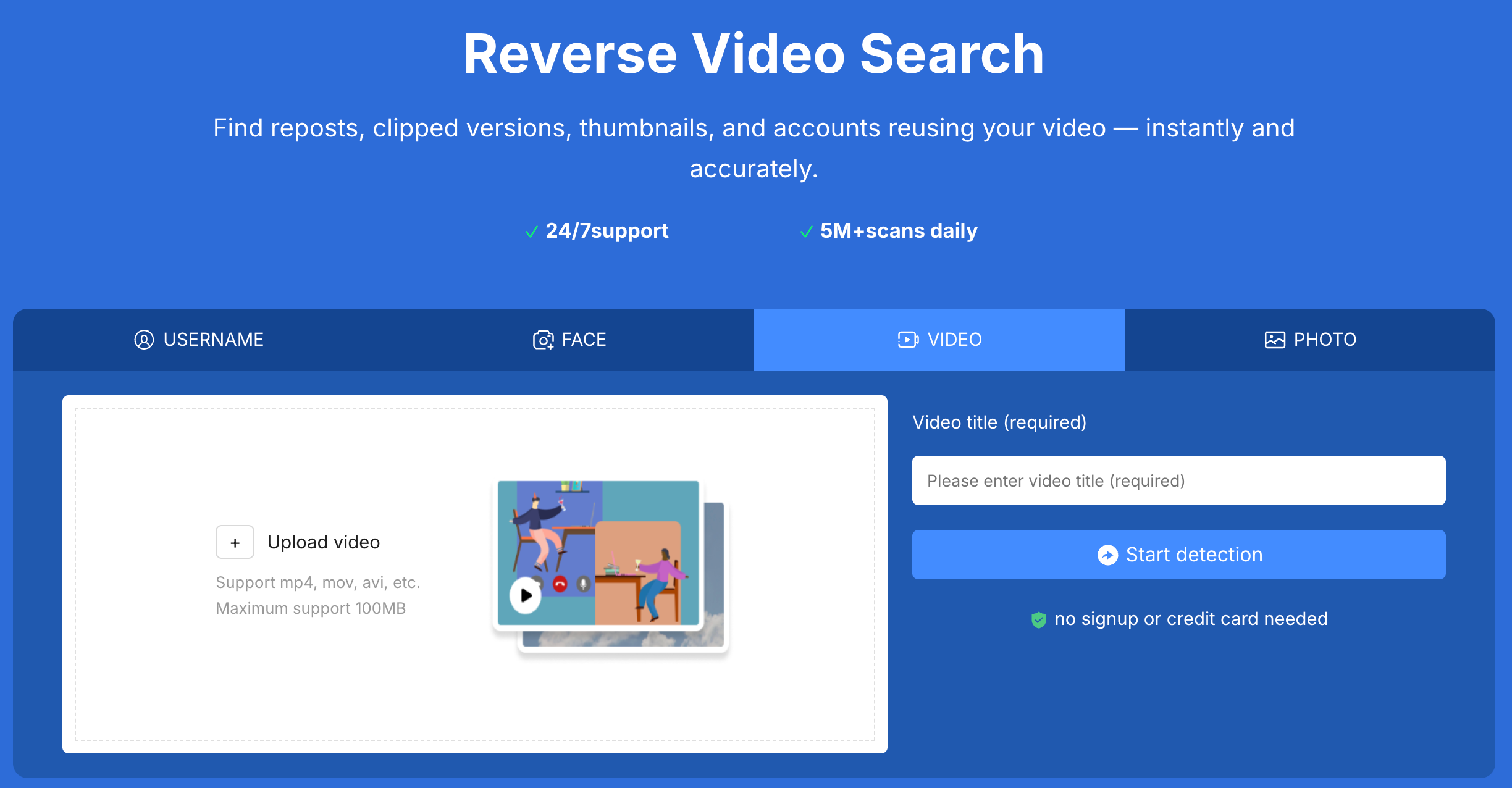
Video leak detection is still far from perfect.
Videos are frequently altered before being reposted, which causes many tools to return incomplete or inaccurate results. On top of that, a large portion of stolen videos circulate through semi-private or private channels that are difficult to index.
Because of these limits, effective monitoring relies on multiple entry points, not a single search method.
Services like Erasa automatically detect and remove stolen content across 100+ platforms by combining frame-based, image-based, and face-based matching. Searching by video covers, key frames, or screenshots often produces far more reliable results than searching by video files alone.
This doesn’t eliminate every blind spot, but it reflects how video leaks actually spread — and how they’re most effectively tracked.
What you do next depends on how widespread the leak is.
If your video appears in only one or two locations, you can often handle it yourself by submitting DMCA takedown requests or reporting copyright infringement through the platform’s official channels, which typically follow DMCA or equivalent copyright frameworks.
When the same video shows up across multiple sites, keeps getting reuploaded, or spreads through harder-to-track channels, manual reporting quickly becomes impractical. In these cases, creators often rely on professional removal services.
Services like Erasa provide ongoing monitoring and takedown handling, helping track new reposts and reduce long-term exposure rather than addressing a single link once.
No method can fully prevent video leaks, but some practices make them harder to sustain.
Limiting access to original files, avoiding reuse of full-length clips across platforms, and running regular checks all help reduce long-term risk.
For videos tied to income or brand value, early detection matters more than complete certainty. Leaks that are found quickly are far easier to contain than those discovered later.
Looking for a PimEyes face search alternative? This page lists reliable options and explains which tools work better for privacy, social media image checks, and misuse detection.
Looking for PimEyes alternatives? Compare safer reverse face search options, understand privacy concerns, and find tools better suited for tracking fake profiles or reused photos.
Learn how to check if your video has been leaked, where stolen videos usually spread, and what to do if your content is reposted without permission.
Reverse image search can’t identify faces. Learn why it fails, how face-search tools work, and how to find where your photos or identity appear online.
Learn why your Twitter (X) reach suddenly dropped. This guide explains the real reasons behind shadowbans and how to confirm your visibility status in minutes.
Learn where to sell feet pics safely, choose secure feet websites, avoid scams, and protect your photos from leaks with smart creator strategies.