Compare 5 Best DMCA Takedown Services for OnlyFans Content
Compare pricing, success-rates & speed of Erasa, Rulta, Enforcity and more to protect leaked OnlyFans content. Free templates & insider tips.


 Fake Account Detection & Removal
 DMCA Takedown Service
 Onlyfans Creator Protection
 Private Photo Protection
 Revenge Porn Removal
 AI Image Abuse Detection
 For Creator
 For Individuals
 General
 Twitter Shadowban Test
 Instagram Shadowban Test
 Tiktok Shadowban Test
 Creator Platform Comparison Tool
 OnlyFans Restricted Words Checker
 OnlyFans Caption Generator
 Blog
Blog DMCA Guides
 Affiliate Program
 Email
Email X(Twitter)
 Telegram
Dating apps and social platforms are designed to lower friction.
You can start talking to someone in minutes, often without knowing much about who they really are.
That same convenience also makes it easier for incomplete or misleading identities to blend in.
Profiles can look convincing long before they’re verifiable.
When something feels off—too polished, too fast, or too inconsistent—images are usually the first place where cracks start to show.
Stories can be rehearsed. Messages can be scripted.
Photos are harder to control.
In many catfishing cases, profile images reveal:
That’s why catfish photo search and catfish face search are often the first practical checks people use when something feels off.
In real dating and social contexts, catfishing is rarely obvious at the beginning.
It tends to show up as small mismatches rather than outright lies—photos that don’t align with behavior, personal details that shift over time, or an identity that feels assembled rather than lived.
Most cases aren’t about creating a completely fictional person.
They involve borrowing credibility—from someone else’s photos, a real person’s appearance, or a partially constructed online presence—resulting in false or impersonated identities that are hard to question at first glance.
Romance-based catfishing often prioritizes emotional momentum over consistency.
Profiles may appear warm, attentive, and carefully curated, while offering very little that can be independently verified.
Photos look appealing, but the surrounding details—activity history, social connections, or long-term presence—remain thin or fragmented.
The goal isn’t to appear fake.
It’s to appear just believable enough to move the conversation forward before questions arise.
A frequent pattern involves using images that belong to a real person who has no connection to the profile itself.
These photos may come from public social media accounts or older online posts, making them difficult to question at first glance—especially when paired with a convincing backstory.
Some fake accounts are created not to deceive romantically, but to target, provoke, or damage someone else’s reputation.
In these cases, photos are often reused to give the account a sense of legitimacy or anonymity at the same time.
Not all catfishing cases are tied to money.
Some rely on attention, validation, or emotional dependence, using a mismatched identity to maintain long-term interaction rather than extract immediate value.
In dating scam identity cases, requests for money or favors usually come only after trust has been established.
Photos serve as the initial layer of credibility, making later requests seem more reasonable than they should.
Photo-based checks can quickly surface inconsistencies that aren’t obvious in conversation.
Useful signals include:
This type of scammer photo search doesn’t tell you who someone is—but it can make it clear when an identity doesn’t add up.
Not every suspicious profile uses obviously stolen images.
Some fake accounts rely on:
In these situations, the image itself may look legitimate, while the identity behind it remains false.
This is where checking broader online presence matters more than a single match.
Real people usually leave consistent traces over time.
That might include:
By contrast, many social media fake profiles exist in isolation—appearing on only one platform, with no clear history or external connections.
Trying to find a person by face across platforms helps reveal whether an identity stands on its own or connects to something real.
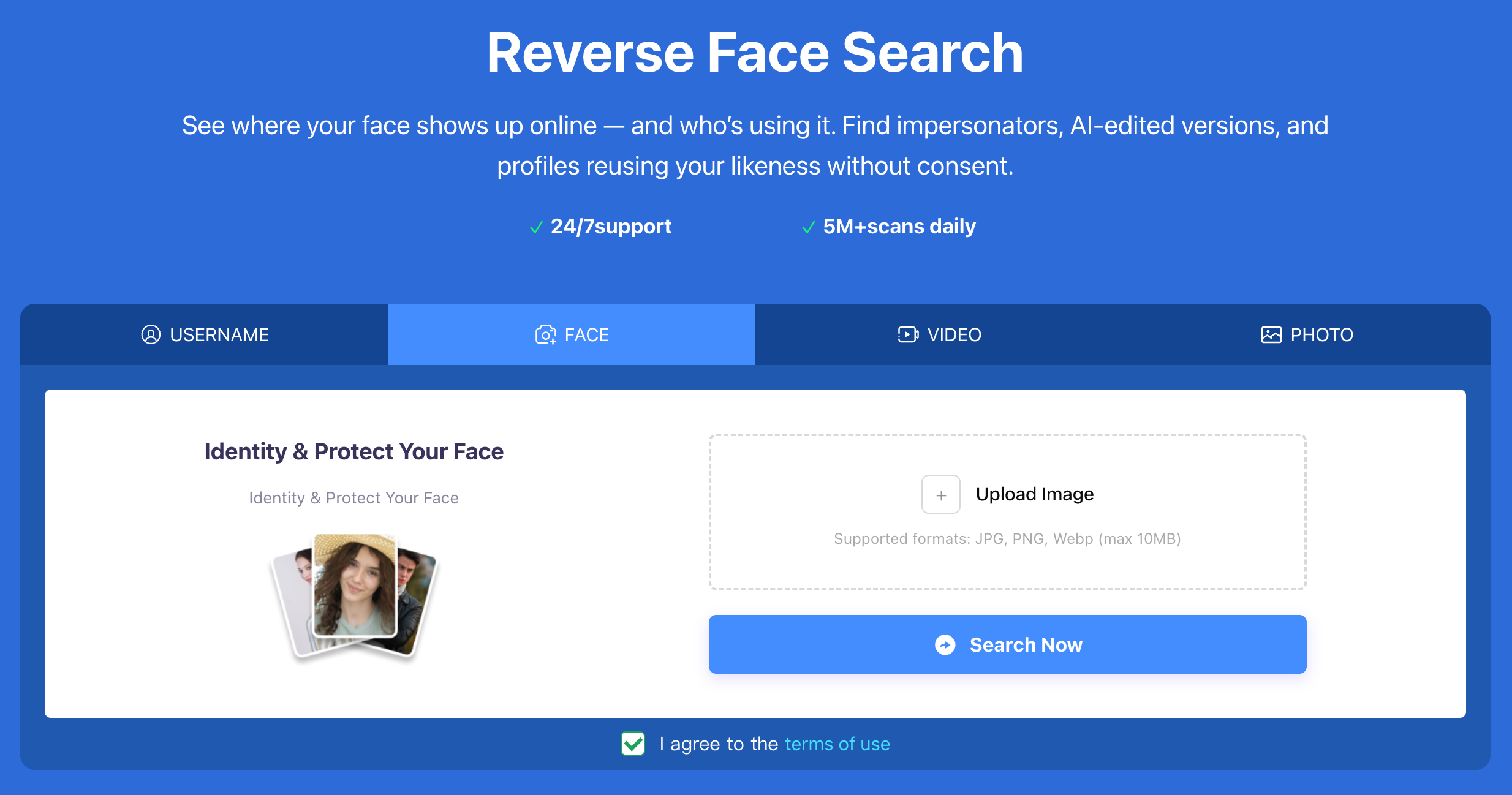
Photo-based verification is useful, but it has limits.
It can help you:
It can’t:
Think of reverse photo and face checks as a way to reduce uncertainty, not a way to establish absolute proof.
If verification raises concerns, the priority is protecting yourself—not confronting the other person.
Practical responses include:
In dating scam situations, stepping away early is often the safest choice.
How can you tell if someone is catfishing you?
Look for identity inconsistencies, especially reused photos, single-platform presence, or details that don’t align.
Can a real photo still be used for catfishing?
Yes. Many catfish profiles use real images that belong to someone else.
Is photo search reliable for detecting dating scams?
It’s one of the fastest ways to surface red flags, especially when combined with cross-platform checks.
What if a profile only exists on one platform?
A lack of broader presence can indicate a fabricated or incomplete identity.
Can you confirm someone’s real identity from a photo?
No. Photos help reveal impersonation and inconsistencies, not legal identity.
Catfishing today is rarely obvious.
It’s usually about mismatched or incomplete identities, not cartoonish fake photos.
Photo and face-based checks help you recognize those mismatches early—before trust, emotion, or money become involved.
Compare pricing, success-rates & speed of Erasa, Rulta, Enforcity and more to protect leaked OnlyFans content. Free templates & insider tips.
Learn how to protect your adult-oriented content on X (Twitter) with ERASA’s streamlined DMCA tools. Step-by-step guide + free template.
OnlyFans creators use DMCA takedowns to fight leaks — but they don’t always work. This guide explains when DMCA takedowns are effective, where they fail, and how creators handle repeated leaks in practice.
Learn how to remove leaked OnlyFans photos and videos from websites, search results, and social platforms—using proven DMCA takedown steps that actually work.
Worried about catfishing or fake identities in dating apps? Use photo and face search techniques to spot impersonation before it turns into a scam.
Stop image theft now. Use our professional duplicate photo finder to search for duplicate pictures across the web and social media. Detect reuploads and protect your work today.