Compare 5 Best DMCA Takedown Services for OnlyFans Content
Compare pricing, success-rates & speed of Erasa, Rulta, Enforcity and more to protect leaked OnlyFans content. Free templates & insider tips.

 Fake Account Detection & Removal
 DMCA Takedown Service
 Onlyfans Creator Protection
 Private Photo Protection
 Revenge Porn Removal
 AI Image Abuse Detection
 For Creator
 For Individuals
 General
 Twitter Shadowban Test
 Instagram Shadowban Test
 Tiktok Shadowban Test
 Creator Platform Comparison Tool
 OnlyFans Restricted Words Checker
 OnlyFans Caption Generator
 Blog
Blog DMCA Guides
 Affiliate Program
 Email
Email X(Twitter)
 Telegram
If you’ve already removed leaked OnlyFans content from a website but still see it showing up in Google search results, you’re not alone.
This happens because removing content from a site and removing it from Google are two different processes. Even when a post, image, or video is taken down, Google may continue to display cached links, indexed pages, or mirrored URLs for weeks — sometimes longer.
This guide explains how Google handles leaked content, what you can realistically fix at each stage, and how creators confirm whether anything is still circulating before filing removal requests.
 Add Account
Google does not actively monitor whether leaked content is authorized or not. It simply indexes URLs it has already discovered.
Common reasons leaked content remains visible include:
Because of this, creators often believe their content is “gone” when in reality only one copy was removed.
Before submitting removal requests, you need to confirm what Google is still indexing.
Many creators start by manually searching their username or image, but this rarely reveals the full picture.
Google may index:
This is why the first practical step is to verify whether your content is still discoverable through Google search results, rather than guessing based on one or two queries.
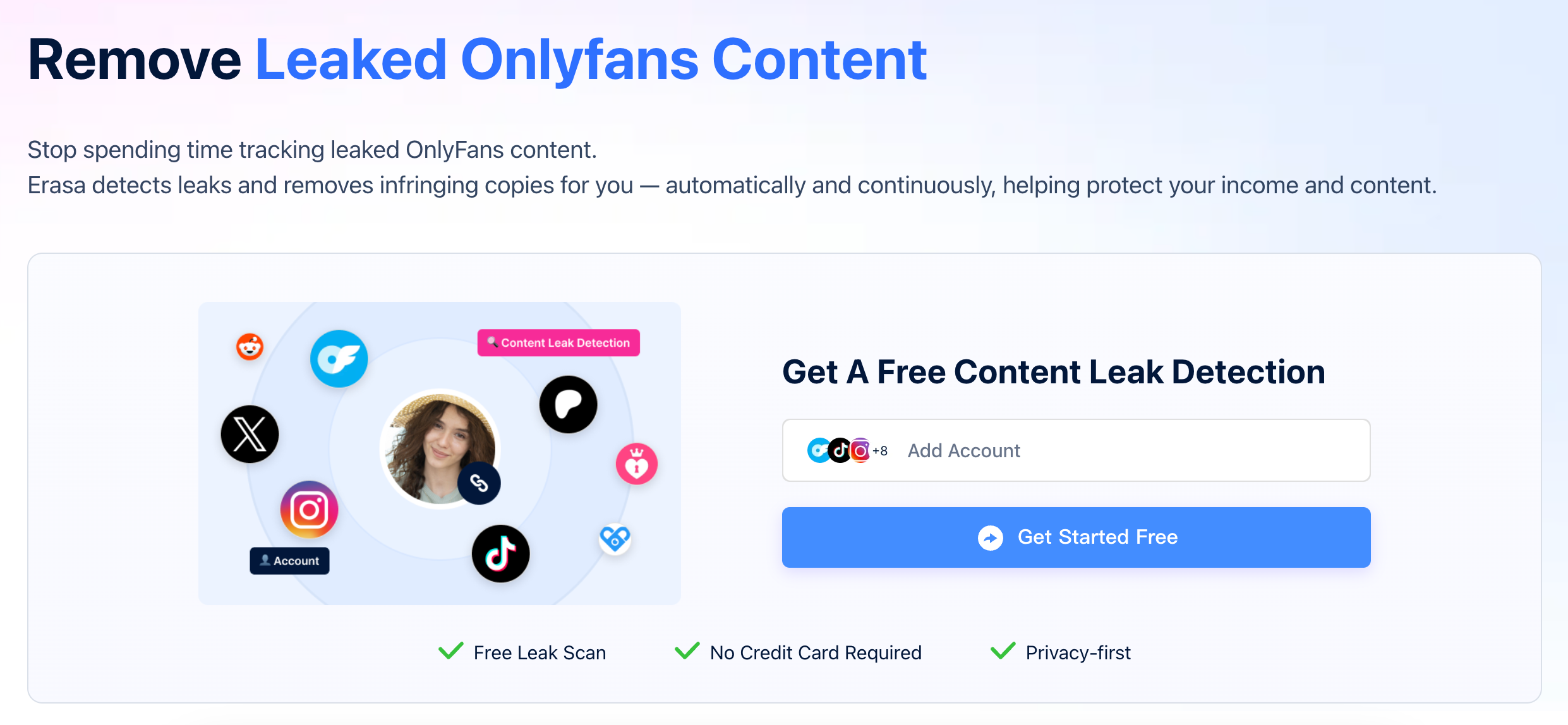
A reliable way to do this is to detect leaked OnlyFans content across Google-indexed pages, so you know exactly which URLs are still visible before taking action.
Once you have confirmed which links are indexed, removal generally happens through two paths.
You can submit requests through Google’s legal or content removal channels when:
This approach works best when the number of links is small and the reposting is limited to one or two sites.
However, manual requests do not prevent new URLs from appearing later.
If the same content keeps reappearing under new URLs, the issue is no longer a single removal — it’s re-distribution.
In these cases, creators focus on monitoring Google-indexed results continuously, so leaked content can be flagged and addressed before it gains visibility again.
This is where automated leak detection becomes useful: not to replace removal requests, but to ensure you’re not constantly reacting after damage has already been done.
Google removal is reactive by nature. Prevention relies on reducing how easily content can be reused.
Effective measures include:
No method fully eliminates leaks, but early detection significantly reduces how long content remains searchable.
Manual removal usually works when:
Monitoring becomes necessary when:
The key is knowing which situation you’re in — and that starts with visibility, not assumptions.
Removing leaked OnlyFans content from Google isn’t about filing more requests — it’s about understanding what Google can still see.
Once you know what’s indexed, removal becomes a process instead of a guessing game.
Creators who start with visibility save time, avoid unnecessary requests, and regain control faster.
Q1: If the leaked content is removed from the website, why does it still appear on Google?
Because Google indexes pages independently. Even after a post is deleted, cached results, image previews, or previously discovered URLs may remain visible until Google re-crawls and updates its index.
Q2: How long does it usually take for Google to remove leaked content from search results?
There is no fixed timeline. Some URLs disappear within days, while others remain indexed for weeks depending on crawl frequency, content type, and whether similar copies exist elsewhere.
Q3: Do I need to submit a removal request for every leaked link?
Yes. Google processes URLs individually. If the same content appears under multiple links or domains, each indexed URL must be identified before it can be removed.
Q4: Are images and videos treated differently by Google search?
Yes. Images often persist longer due to caching and reuse across sites, while videos may reappear through re-uploads or embedded players, even after the original source is removed.
Compare pricing, success-rates & speed of Erasa, Rulta, Enforcity and more to protect leaked OnlyFans content. Free templates & insider tips.
Learn how to protect your adult-oriented content on X (Twitter) with ERASA’s streamlined DMCA tools. Step-by-step guide + free template.
OnlyFans creators use DMCA takedowns to fight leaks — but they don’t always work. This guide explains when DMCA takedowns are effective, where they fail, and how creators handle repeated leaks in practice.
Learn how to remove leaked OnlyFans photos and videos from websites, search results, and social platforms—using proven DMCA takedown steps that actually work.
Worried about catfishing or fake identities in dating apps? Use photo and face search techniques to spot impersonation before it turns into a scam.
Stop image theft now. Use our professional duplicate photo finder to search for duplicate pictures across the web and social media. Detect reuploads and protect your work today.